Talks & Events
Clarissa - AfroSwissters at Zurich Film Festival (ZFF)
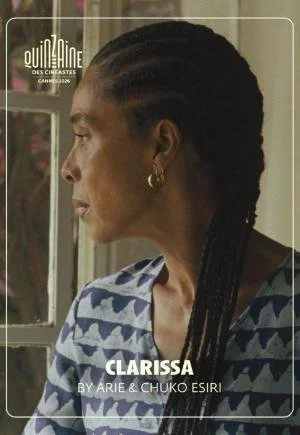
Panel: AfroSwissters × Zurich Film Festival
Date: 3 October 2026
Time: 16:45–17:25
Location: Zurich
Panel:
Moderator: Amina Charles (AfroSwisster)
Speakers: Emma Mavodza + Serafina Andrew
As part of the Zurich Film Festival, I will join an AfroSwissters panel discussion centered on Clarissa, the new film by Nigerian twin filmmakers Arie and Chuko Esiri.
Set in contemporary Lagos, Clarissa reimagines Virginia Woolf’s Mrs Dalloway through the life of a prominent Lagos society wife. As Clarissa prepares for a party, the film moves through memories of her youth, relationships, and the decisions that have shaped the life she ultimately built. The film stars Sophie Okonedo, Ayo Edebiri, and David Oyelowo.
The conversation brings together different perspectives and generations to reflect on the film and the questions it opens up around Black life, representation, interiority, gender, relationships, and contemporary African cinema.
My contribution draws on my research in film and visual culture, particularly my work on Blackness, representation, and affect. I am interested in how contemporary cinema negotiates Black interiority and emotional life, and in what becomes possible when Black characters are approached not primarily as representational symbols, but through the complexities of everyday experience, memory, desire, and social relation.
Echt jetzt? Fotografie/Film und KI/AI
Conference
25.09.2026
The conference “Echt jetzt? Fotografie/Film und KI/AI” examines how the field is framed by law and legislation, as well as the practical ways in which image creators, viewers, museums, and archives engage with AI-generated imagery. A new field of research within an interdisciplinary cultural studies context is taking shape, situated between emerging creative, practical, and scholarly possibilities and pointed criticism of these new images (regarding issues such as the provenance of training data, energy consumption, the distortion of history, and their power of suggestion).
Panel 3 : Grenzen und Möglichkeiten: Diesseits und jenseits der Fotografie
Chair: Ulrich Hägele (Univerisität Tübingen)
Speakers: Martin Frech, Christian Sinn, Jörg Müller, Luzie Ronkholz, Serafina Andrew
My presentation:
Optimierte Ambiguität: KI, visuelle Normierung und die Extraktion Schwarzer Ästhetiken
This presentation examines AI-assisted image production as a racialized visual regime, moving beyond understandings of artificial intelligence as a neutral technological tool to consider how it participates in the production and normalization of visual difference. As generative AI and automated image-editing increasingly shape everyday visual cultures, they also encode particular assumptions about skin, light, facial features, and beauty—assumptions that remain deeply entangled with Eurocentric aesthetic standards.
Drawing on a digital ethnography of Instagram content conducted between 2025 and 2026, I focus on three interconnected dynamics: the algorithmic lightening of skin tones and standardization of facial features; the proliferation of racially ambiguous, predominantly female-coded AI figures; and the extraction and recirculation of visual styles associated with Black creators. I argue that racial ambiguity becomes particularly significant within these visual economies because it operates as a form of optimization: difference remains visible and aesthetically desirable, while being rendered sufficiently indeterminate to remain compatible with dominant visual norms.
At the same time, these processes extend beyond representation itself. Black aesthetics can become detached from the creators, histories, and cultural contexts through which they acquire meaning, transformed into reproducible visual resources that can be generated, modified, and recirculated across platforms. AI therefore does not simply reproduce existing representational inequalities but introduces new possibilities for the extraction and redistribution of racialized aesthetic forms.
By bringing questions of visual normativity, racial ambiguity, and aesthetic extraction into conversation, the talk proposes an approach to AI-generated imagery that understands artificial intelligence not simply as a tool but as a culturally situated system of visual production. It asks what happens when racial difference becomes something that can be computationally optimized—and what forms of visibility, erasure, and appropriation emerge in the process.
Diversity on Screen?!
Symposium
Materials, Categories, and Methods of Analyzing Representation in Film and Media
Panel Discussion + Presentation
13.06.2026
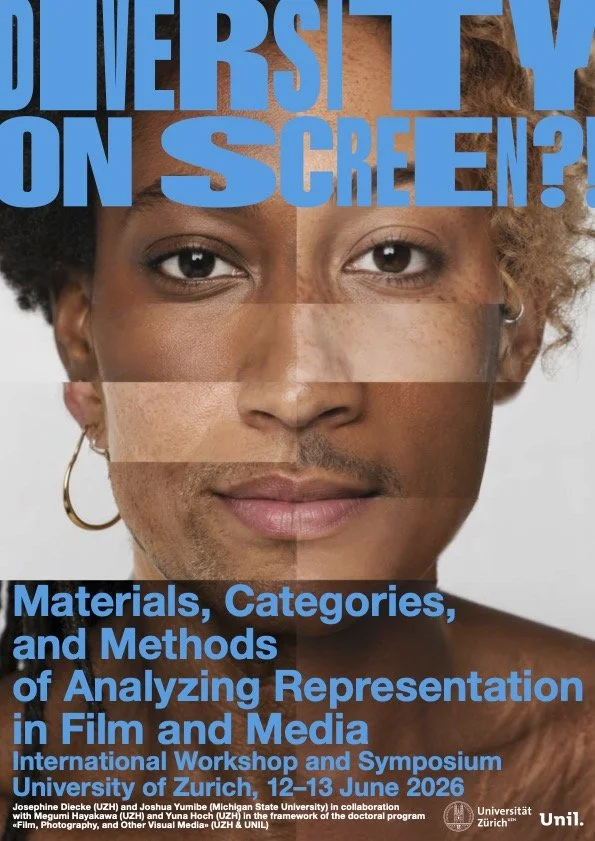
I will be presenting at the symposium Diversity on Screen?!, hosted by the Department of Film Studies at the University of Zurich. The event brings together researchers across career stages to critically engage with the materials, categories, and methods through which representation in film and media is analyzed.
Panel 2 : Representation & Intersectionality
Chair: Joshua Yumibe
Speakers: Serafina Andrew, Congle Fu, Laura Katharina Mücke, Rebecca Zorko
Keeping Them Comfortable:
Self-Reflexive Blackness and Affective Labor in Contemporary Film
This presentation engages with ongoing debates on diversity in film, moving beyond questions of visibility to examine the conditions that structure representation itself. While earlier cinematic formations, from externally imposed racial stereotypes to the ambivalent negotiations of Blaxploitation, have shaped how Blackness appears on screen, contemporary films increasingly turn toward reflecting on these very conditions.
Focusing on The American Society of Magical Negroes, I analyze how the film makes explicit a central but often implicit demand: the expectation that Black subjects regulate white emotional comfort. By staging this dynamic within a fictional institutional framework, the film offers a self-reflexive engagement with the trope of the “Magical Negro,” exposing the affective labor historically embedded in representations of Blackness.
At the same time, this reflexivity produces a fundamental ambivalence. While the film critiques the conditions of racialized performance, it also risks reinscribing whiteness as the primary horizon through which Blackness becomes legible. Rather than resolving this tension, the presentation foregrounds it as symptomatic of a broader dilemma within contemporary diversity discourse: the difficulty of escaping the very structures it seeks to critique.
By centering narrative self-awareness and affective regulation, the talk proposes an interpretive approach to “diversity on screen” that attends to the underlying conditions through which representation becomes intelligible in the first place.
Abolish!
Abolition as Practice:
Visibility, Imagination, and the Politics of Possibility?
Opening Talk (Politmonat)
22.05.2026
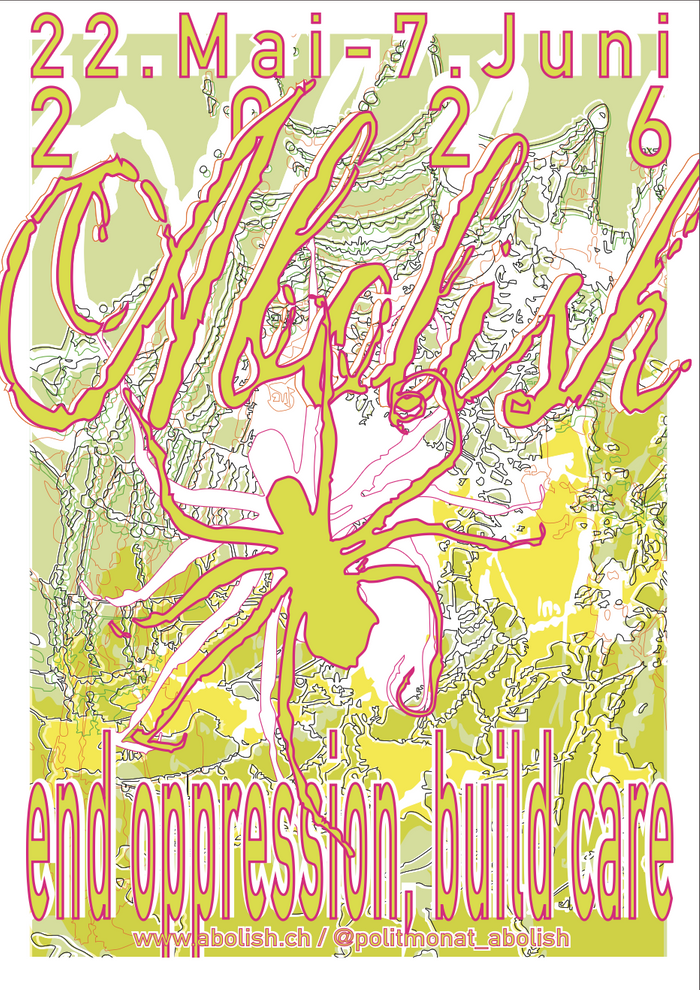
As part of the kickoff for the Abolish! program, I will give a talk that rethinks abolition not only as a historical movement, but as a contemporary political and cultural practice.
Abolition as Practice: Visibility, Imagination, and the Politics of Possibility
Building on classical abolitionist theory, the talk explores how abolitionist perspectives circulate, become visible, and gain meaning today, particularly within visual cultures, digital spaces, and political discourse. At its core are questions of representation: Who is included in abolitionist narratives, and who remains invisible? Which images of resistance dominate, and which bodies, experiences, and perspectives are excluded?
Rather than approaching abolition solely as a demand for dismantling systems, the talk frames it as a project of imagination, an invitation to think through new forms of coexistence, care, and belonging. By bringing together political urgency and a cultural studies perspective, the talk opens up a space in which abolition can be understood as an ongoing, dynamic, and collective process.
The talk will be followed by a moderated group discussion, creating room for shared reflection and exchange.
Screen Dialogs
The last Angel of History
Film Screening + Conversation
07.05.2026

As part of Dominique White’s exhibition All Great Powers Collapse from the Centre at Kunsthalle Basel, Screen Dialogs presents a curated film and discussion program in collaboration with Stadtkino Basel.
The evening features a screening of John Akomfrah’s film essay The Last Angel of History, a seminal work that brings together Afrofuturist and Afropessimist perspectives on history, memory, and speculative futures.
Following the screening, I will join a live conversation moderated by Ananda Jade, engaging with key themes emerging from both the film and the exhibition. The dialogue will explore questions of archival practice, visual culture, and the ways in which images shape and reconfigure our understanding of time, history, and possibility.
Working across photography, cultural studies, and film studies, my research focuses on the intersections of visual culture, postcolonial theory, and digital media, an approach that informs the discussion and situates it within broader contemporary debates.
Abolish!
Opening Lecture (Politmonat)
09.05.2025
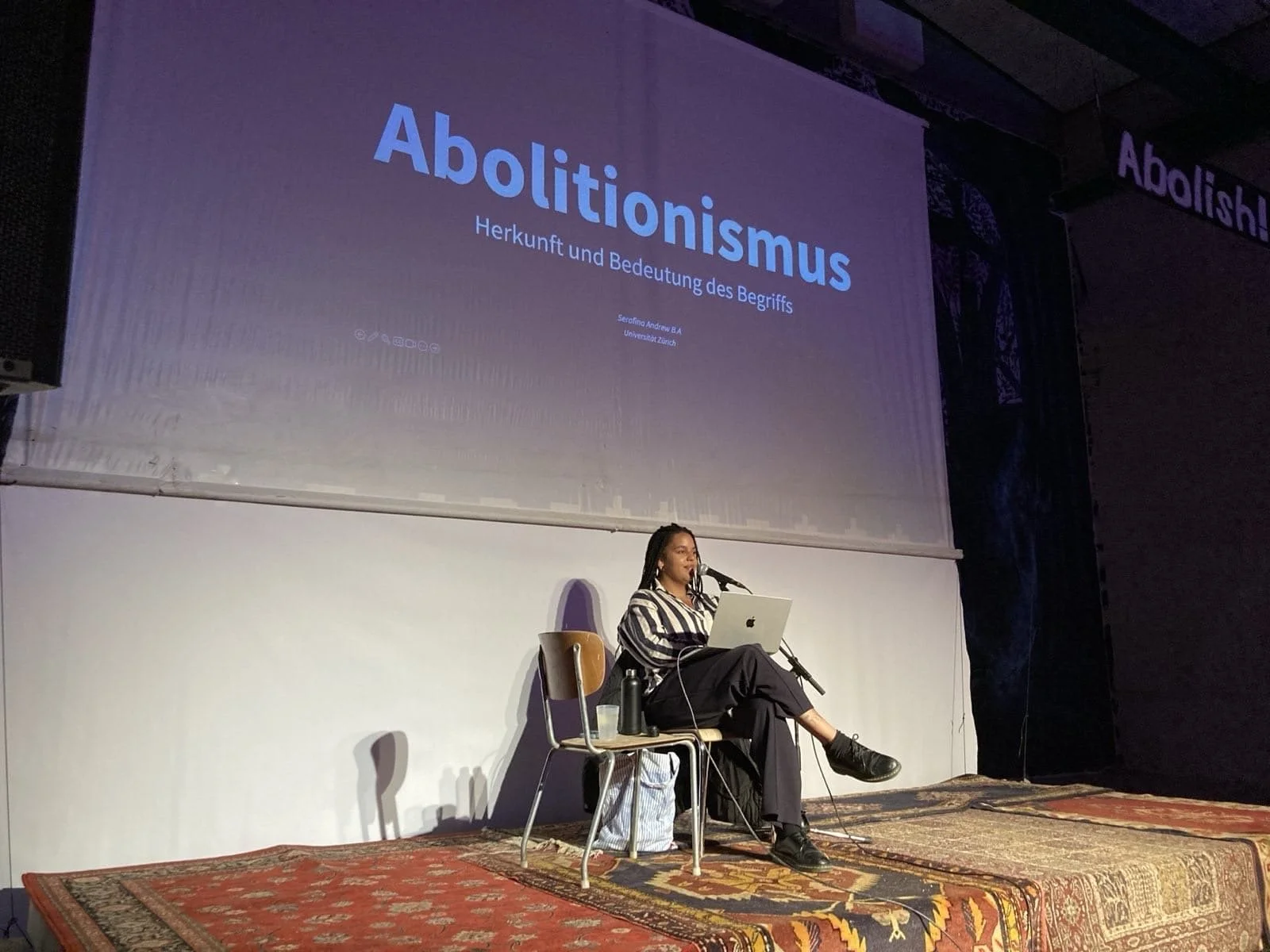
I had the honour of opening Abolish! as part of the Politmonat with a public lecture on the history and contemporary significance of abolitionism. The talk introduced abolitionism as both a historical movement and a present-day critical framework, tracing its roots from the struggle against transatlantic slavery to current debates around prisons, policing, and social control.
Drawing on Stuart Hall’s theory of political representation, I connected historical abolitionist thought with contemporary questions of visibility, belonging, and resistance, with particular attention to digital images and visual cultures of protest. My research on biracial identities and Black cultural spaces informed the discussion, opening a space to think about ambivalence, recognition, and radical forms of inclusion within abolitionist imaginaries.
The lecture was conceived as a conceptual and contextual grounding for the month-long programme, providing a shared theoretical vocabulary and historical frame for subsequent events, discussions, and interventions.